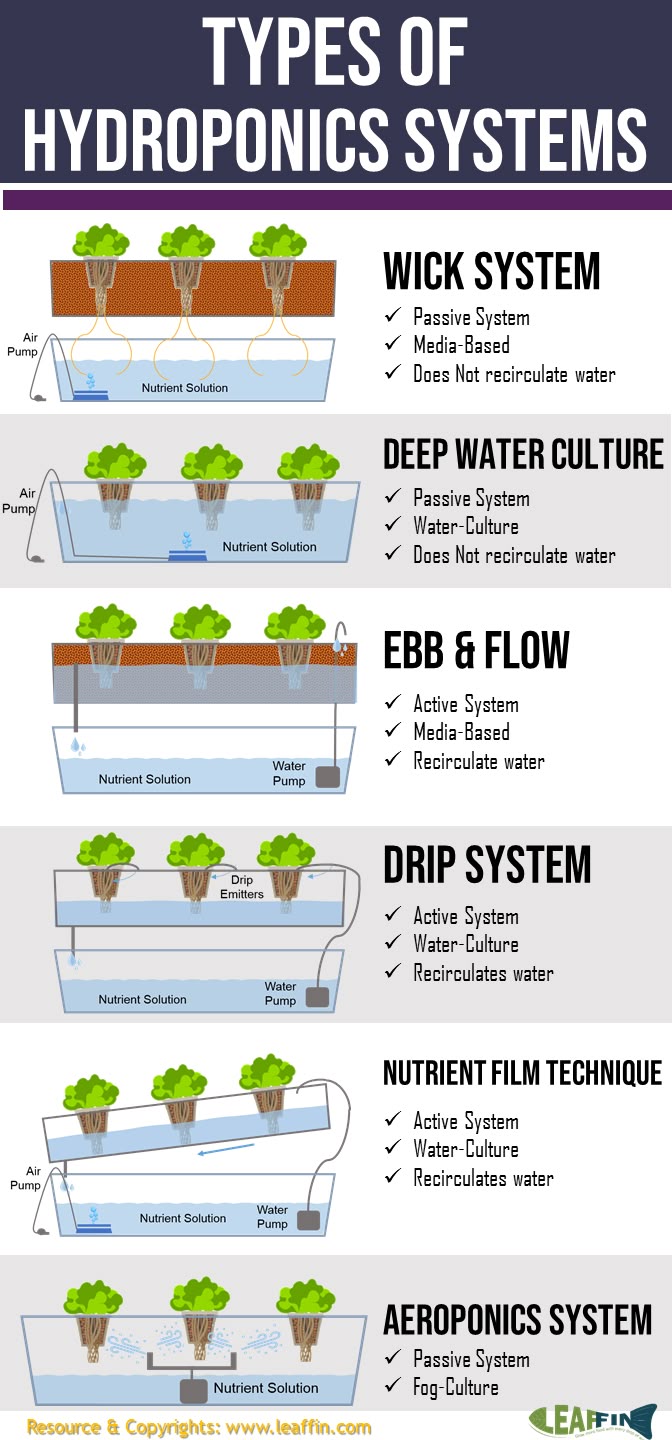
If you’re exploring hydroponic systems for beginners, the sheer number of types can be paralyzing. Deep water culture, NFT, ebb and flow, drip systems, aeroponics — every guide seems to assume you already know which one you want..
Here’s a straightforward breakdown of the main hydroponic system types, and which one actually makes sense if you’re just getting started.
Deep Water Culture (DWC): The Simplest Starting Point
In a DWC system, plant roots hang directly in an oxygenated nutrient solution, suspended by a net pot floating on or through a lid. An air pump keeps the water oxygenated so roots don’t drown.
DWC is popular with beginners for good reason: it has almost no moving parts, nothing to clog, and it’s forgiving if you check on it once a day instead of hourly. The tradeoff is that it works best for a single plant per bucket, so it doesn’t scale well if you want to grow many plants at once.
Best for: first-time growers, leafy greens, herbs, single-plant experiments.
Nutrient Film Technique (NFT): Efficient but Less Forgiving
NFT systems continuously pump a thin film of nutrient solution across the bottom of a sloped channel, where plant roots sit in trays or net pots. It’s water-efficient and scales well for multiple plants in one system.
The catch: NFT depends entirely on your pump running constantly. If the pump fails or clogs, roots dry out fast — sometimes within hours. This makes it a step up in complexity, better suited to growers who’ve already got the basics of nutrient and pH management down.
Best for: growers ready to scale up after a successful first system, leafy greens and herbs in larger quantities.
Ebb and Flow (Flood and Drain): Flexible, More Equipment
This system periodically floods a grow tray with nutrient solution, then drains it back into a reservoir, on a timer. Roots get regular access to both nutrients and oxygen as the water level rises and falls.
Ebb and flow systems handle a wider range of plants than DWC or NFT, including larger vegetables. But they require more components (timer, pump, tray, drainage) and more things that can go wrong — timer failures or drainage clogs are the most common headaches.
Best for: growers wanting more plant variety, those comfortable troubleshooting basic mechanical issues.
Drip Systems: The Most Versatile, Most Complex
Drip systems deliver nutrient solution directly to the base of each plant through individual drip lines, then either recirculate or drain the runoff. This is what most large-scale commercial hydroponic operations use, because it allows precise control over exactly how much solution each plant gets.
For a beginner, drip systems are usually overkill — more parts, more tuning, more troubleshooting surface area than the payoff justifies for a first attempt.
Best for: growers scaling toward a serious home operation, mixed plantings needing different feeding schedules.
Aeroponics: High Reward, High Risk
Aeroponic systems suspend roots in air and mist them with nutrient solution at frequent intervals, without any growing medium. This gives roots maximum oxygen access, often producing the fastest growth of any hydro method.
It’s also the least forgiving system on this list. Because roots aren’t in water or medium, even a short mister failure can cause rapid, sometimes irreversible root damage. This isn’t a beginner system.
Best for: experienced growers chasing maximum growth rates.
So Which One Should You Actually Start With?
For almost everyone starting out, Deep Water Culture is the right first system. It teaches you the fundamentals — pH management, nutrient concentration, oxygenation — without punishing small mistakes the way NFT or aeroponics will. Once you’ve run a DWC bucket successfully for a full growing cycle, you’ll have a much better sense of whether you want to scale up to something like NFT or ebb and flow.
Whatever system you choose, two things matter more than the system type itself: getting your lighting right and staying on top of pH and nutrient levels. If you ever notice your plants struggling once your system is running, our guide on why hydroponic plants turn yellow walks through the most common causes.
Frequently Asked Questions
Do I need to buy a kit, or can I build my own system?
Either works for beginners. Kits are more expensive but remove guesswork; building your own DWC system from a bucket, net pot, and air pump costs very little and teaches you the mechanics firsthand.
How long before I see results with hydroponics?
Faster than soil in most cases — many leafy greens are ready to harvest in 3-5 weeks with a properly running DWC system, compared to 6-8 weeks in soil.
Can I mix plant types in the same hydroponic system?
It’s possible but easier to avoid as a beginner. Different plants often want different nutrient concentrations and pH targets, so starting with one plant type per system keeps troubleshooting simple.
What’s the biggest mistake beginners make?
Neglecting pH monitoring. Even a perfect nutrient mix becomes useless if pH drifts outside the 5.5–6.5 range where most nutrients are absorbable — checking it daily for your first few weeks builds a habit that prevents most common problems.